
What Is Behavioral Health?
Seen the term “What Is Behavioral Health” on your insurance card, at the doctor’s office, or in a news headline and wondered if it’s just a fancier way of saying “mental health”? You’re not alone. It’s one of the most misunderstood terms in healthcare, and honestly, plenty of providers use it loosely too.
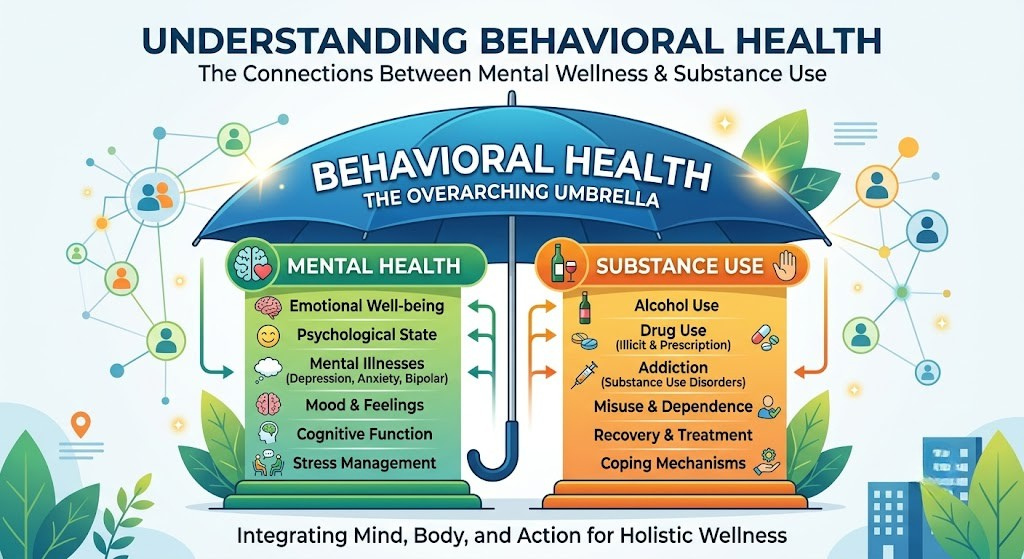
Here’s the short version: That is the umbrella term covering both mental health and substance use, plus how your daily habits and behaviors shape your overall well-being. SAMHSA defines it as the promotion of mental health, resilience, and well-being, the treatment of mental and substance use disorders, and the support of people recovering from those conditions along with their families and communities.
Picture a house. Mental health is one room. Substance use disorders are another. Behavioral health is the whole structure walls, roof, and all the rooms inside it.
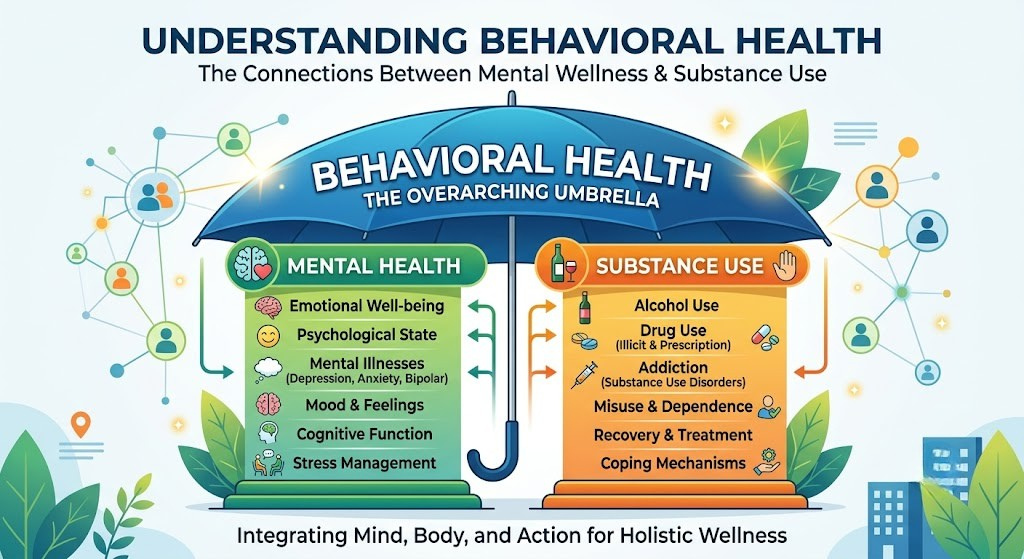
Table of Contents
- What Is Behavioral Health? (Simple Definition)
- Behavioral Health vs. Mental Health: What’s the Difference?
- What Does B>H Actually Cover?
- Why This Term Exists in the First Place
- Signs You Might Need B.H Support
- Common BH Conditions
- How Behavioral H Treatment Works
- BH Integration (Why Your Doctor’s Office Might Ask About This)
- Mistakes People Make When Thinking About
- How to Find BH Care
- FAQs
- Final Thoughts
Behavioral Health vs. Mental Health: What’s the Difference?
This question comes up so often it might as well have its own hotline.
Mental health covers your emotional, psychological, and social well-being how you think, feel, and handle stress. Anxiety, depression, bipolar disorder: all mental health.
Behavioral health is the bigger category. It includes mental health, plus:
- Substance use and addiction (alcohol, drugs, prescription misuse)
- Habits that affect your physical health (eating patterns, sleep, exercise)
- Stress responses and coping behaviors
- Recovery support for anyone managing the above
So every mental health condition counts as a behavioral health issue, but the reverse isn’t true. Take someone struggling with alcohol dependency that’s a behavioral health issue, full stop, even if they’ve never been diagnosed with a mental illness.
This distinction sounds academic until you’re the one trying to find the right provider or figure out what your insurance will actually pay for. Then it matters a lot.
What Does Behavioral Health Actually Cover?
Here’s where things get useful. When a clinic, hospital, or insurance plan says “behavioral health services,” they usually mean:
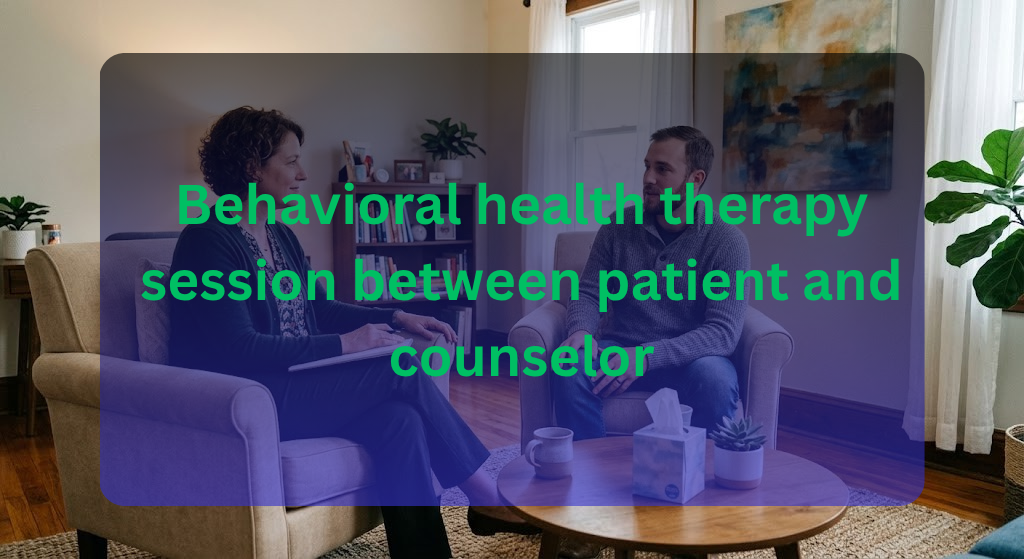
- Mental health counseling and therapy (individual, group, family)
- Psychiatric care, including medication management
- Substance use treatment, from outpatient counseling to detox and residential rehab
- Crisis intervention, like the 988 Suicide & Crisis Lifeline
- Behavioral health integration in primary care, where your regular doctor also screens for depression, anxiety, or substance use
- Prevention and education programs, especially for teens and young adults
People tend to assume behavioral health just means “seeing a therapist.” It’s a lot bigger than that. A support group for someone recovering from opioid addiction? Behavioral health. A school counselor helping a stressed-out kid? Behavioral health. A telehealth visit for medication-assisted treatment? Also behavioral health.
Why This Term Exists in the First Place
This isn’t a softer rebrand of “mental health” meant to dodge stigma, though that’s part of the appeal. The term exists because mental health and substance use are so tangled together that treating them as separate problems often just doesn’t work.
SAMHSA data found that roughly 1 in 5 adults, adolescents, and youth more than 50 million Americans experienced a behavioral health issue between 2019 and 2020. A huge share of those people were dealing with both a mental health condition and a substance use issue at once. Doctors call this a co-occurring disorder, and it’s far more common than most people assume. Treat someone’s depression while ignoring their drinking, or the other way around, and relapse on one front usually drags the other one down with it.
So “behavioral health” isn’t corporate jargon dressed up to sound clinical. It reflects how these conditions show up in real life tangled, not neatly boxed.
Signs You Might Need Behavioral Health Support
You don’t need to hit rock bottom to justify reaching out. A few signs worth paying attention to:
- Feeling persistently down, anxious, or numb for weeks, not just a bad few days
- Sleep or appetite changes that haven’t gone back to normal
- Leaning on alcohol, drugs, or other substances just to get through the day
- Pulling away from people or activities you used to care about
- Small stressors suddenly feeling enormous
- People close to you mentioning, more than once, that they’re worried
Here’s the honest part: a lot of people wait way too long to get help, usually because they’ve convinced themselves their situation “isn’t bad enough” yet. It doesn’t have to be a crisis to be worth addressing. Catching things early is almost always easier, cheaper, and faster than waiting for a full breakdown.
Common Behavioral Health Conditions
Some of the most frequently treated conditions under the B>H umbrella:
- Depression and anxiety disorders
- Bipolar disorder
- PTSD and trauma-related conditions
- Alcohol use disorder
- Opioid and other substance use disorders
- ADHD
- Eating disorders
- Co-occurring disorders (mental illness plus substance use)
About 22% of U.S. adults are affected by mental illness, including depression and anxiety, and more than 5% experience serious mental illness severe enough to interfere with major life activities. Those numbers alone make it clear this isn’t some niche corner of healthcare it’s mainstream.
How Behavioral Health Treatment Works
Treatment isn’t one-size-fits-all, and that’s both the strength and the headache of the whole system. Depending on the situation, care can look like:
- Outpatient therapy — weekly or biweekly sessions, usually the starting point
- Medication management — through a psychiatrist or psychiatric nurse practitioner
- Intensive outpatient programs (IOP) — several sessions a week, for people who need more than weekly therapy but not full hospitalization
- Residential or inpatient treatment — for severe substance use or acute mental health crises
- Peer support and recovery groups — like AA, NA, or SMART Recovery
- Telehealth BH — increasingly common, and genuinely convenient for a lot of people
One trade-off worth knowing: telehealth cuts down on wait times and travel hassle, but it’s not the right fit for someone in acute crisis, or for conditions that benefit from in-person observation, like severe eating disorders or substance withdrawal. If you’re not sure which path makes sense, start with your primary care doctor — they can point you toward the right level of care.
Behavioral Health Integration (Why Your Doctor’s Office Might Ask About This)
Noticed your regular doctor now hands you a quick depression or anxiety questionnaire at checkups? That’s behavioral health integration, and it’s quickly becoming standard practice. Behavioral health care refers to the prevention, diagnosis, and treatment of mental health and substance use disorders, life stressors, and stress-related physical symptoms. The goal is catching problems early, in a setting people already trust, instead of waiting for someone to go track down a separate specialist on their own.
It’s not perfect plenty of primary care doctors have limited time and training for deeper behavioral health issues but it’s a real shift away from treating the body and mind like two unrelated systems.
Mistakes People Make When Thinking About Behavioral Health
A few patterns worth watching for:
- Assuming it’s only for “serious” cases. BH covers everyday stress management and prevention, not just crisis care.
- Treating substance use and mental health as unrelated. They’re frequently connected, and treating one while ignoring the other tends to backfire.
- Assuming insurance won’t cover it. Most U.S. plans are required to cover B>H at parity with physical condition, thanks to federal parity laws though coverage details and provider networks still vary quite a bit.
- Waiting for a “big enough” reason to get help. As mentioned above, this usually just delays care that would’ve been simpler and shorter if it started sooner.
How to Find Behavioral Health Care
If you’re ready to start, here’s a realistic path forward:
- Check your insurance provider’s directory for in-network B>H providers.
- Call SAMHSA’s National Helpline (1-800-662-4357) free, confidential, and available 24/7 for treatment referrals.
- Ask your primary care doctor for a referral, especially if you’re not sure what kind of care fits.
- Use 988 if you or someone you know is in crisis. It connects you directly to the Suicide & Crisis Lifeline.
- Look into community mental health centers, many of which offer sliding-scale fees based on income.
FAQs
Is behavioral health the same as mental health?
No. Mental health is part of behavioral health, but behavioral health also includes substance use disorders and behavior-related health issues.
What’s an example of a behavioral health disorder?
Depression, alcohol use disorder, PTSD, and ADHD all fall under B>H.
Who provides behavioral health services?
Psychiatrists, psychologists, licensed therapists, social workers, addiction counselors, and psychiatric nurse practitioners all provide care centers.
Does insurance cover behavioral health?
Most U.S. health plans are required to cover behavioral health services, though specifics like copays, session limits, and in-network providers vary by plan.
What is behavioral health integration?
It’s when condition screening and care get built directly into primary care visits, so mental health and substance use issues can be caught earlier.
Final Thoughts
Behavioral health isn’t a trendy rebrand or a vague catch-all phrase it earns its place because mental position and substance use rarely exist in isolation from each other. Once you start seeing BH as the full picture instead of two separate boxes, it gets a lot easier to figure out what kind of support actually fits your situation.
If something in this article hit close to home the sleep changes, the drink you rely on to unwind, the anxiety that won’t quiet down that’s worth a real conversation with a professional, not something to sit on.
Need support right now? Call or text 988 for the Suicide & Crisis Lifeline, or reach SAMHSA’s National Helpline at 1-800-662-4357 for free, confidential treatment referrals.